Prove your crypto never left the regulated loop.
Built for accountants.
NetoFi reconstructs the complete circuit of your funds — from your bank deposits, through exchanges on your bank's whitelist, across every wallet you own (including the ones it discovers you forgot) — and proves nothing entered unexplained. Out-of-policy activity is isolated lot by lot, so the clean part stays wirable. Your true portfolio — DeFi and open futures at their real value — with a full, traceable tax report included.
NetoFi is in beta, and free of charge while it is.
Three things our tool excels at
A closed-loop proof — not a risk score
Screening tools answer "is anything bad nearby?". We prove the positive: every holding traces to your bank deposits via exchanges on your bank's own whitelist (Bank Leumi today) — however many hops it takes. Anything that stepped outside the policy is fenced off lot by lot, with the exact transaction where it happened, so the clean part stays bank-ready.
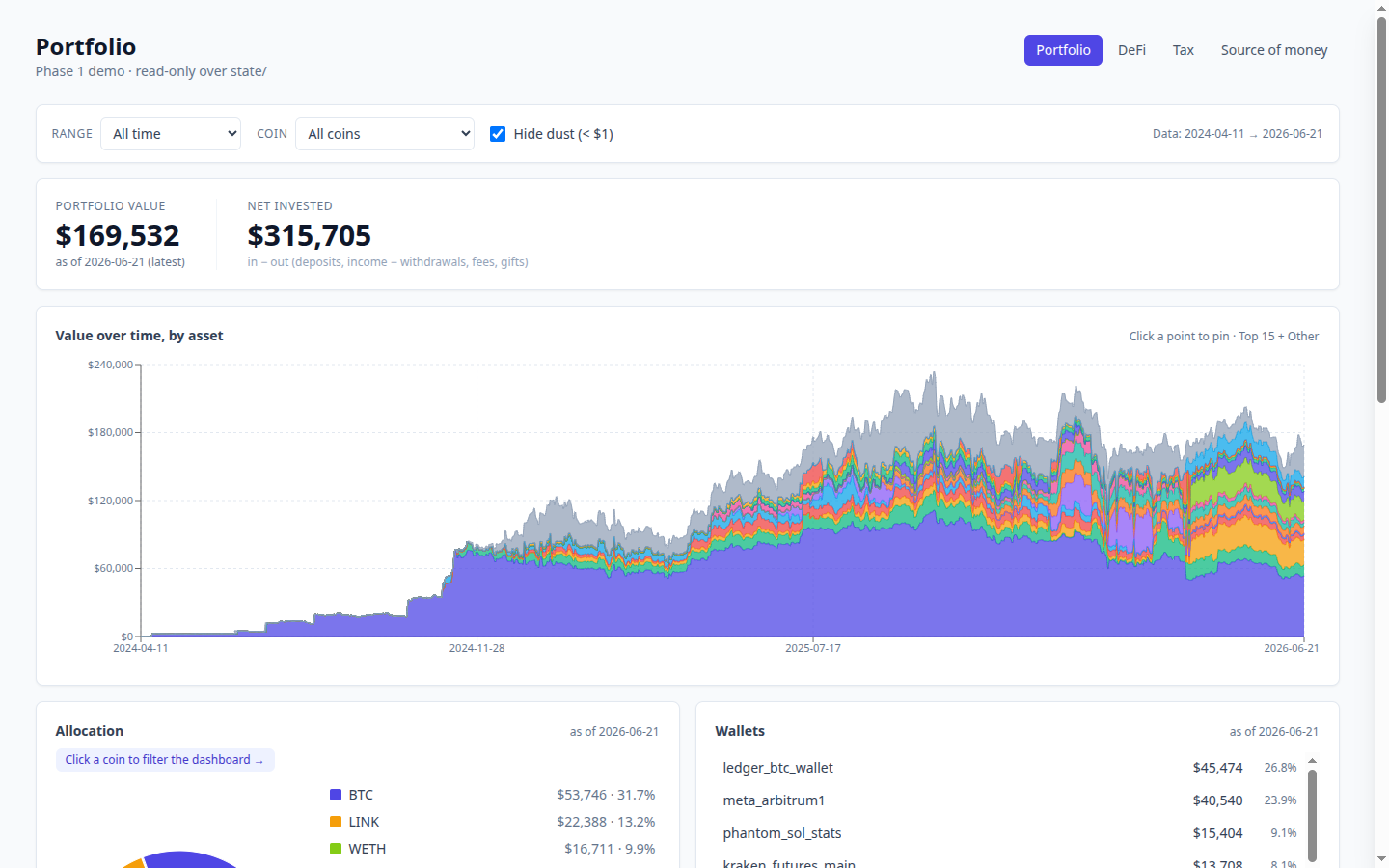
Your true portfolio — every position at its real value
In other tools, the moment you provide liquidity on Uniswap, deposit into Aave, or open a perp, that value drops off the balance and the chart — a portfolio worth a fraction of what the exchange shows. Here every position stays: liquidity, lending, staking and open futures, valued today and at every point in history. If the exchange shows it, your portfolio shows it.
Complete by construction
A proof is only as strong as the wallet list behind it — and every other tool trusts the client's memory. We start from the accounts only the client could know about and follow the money outward, layer by layer, presenting each counterparty with its evidence for a mine / not-mine call. No forgotten wallet, no phantom gain, no "is this all of it?" left open.
A tour of the dashboard
Five tabs, each built to show its work — over a real, complex portfolio.
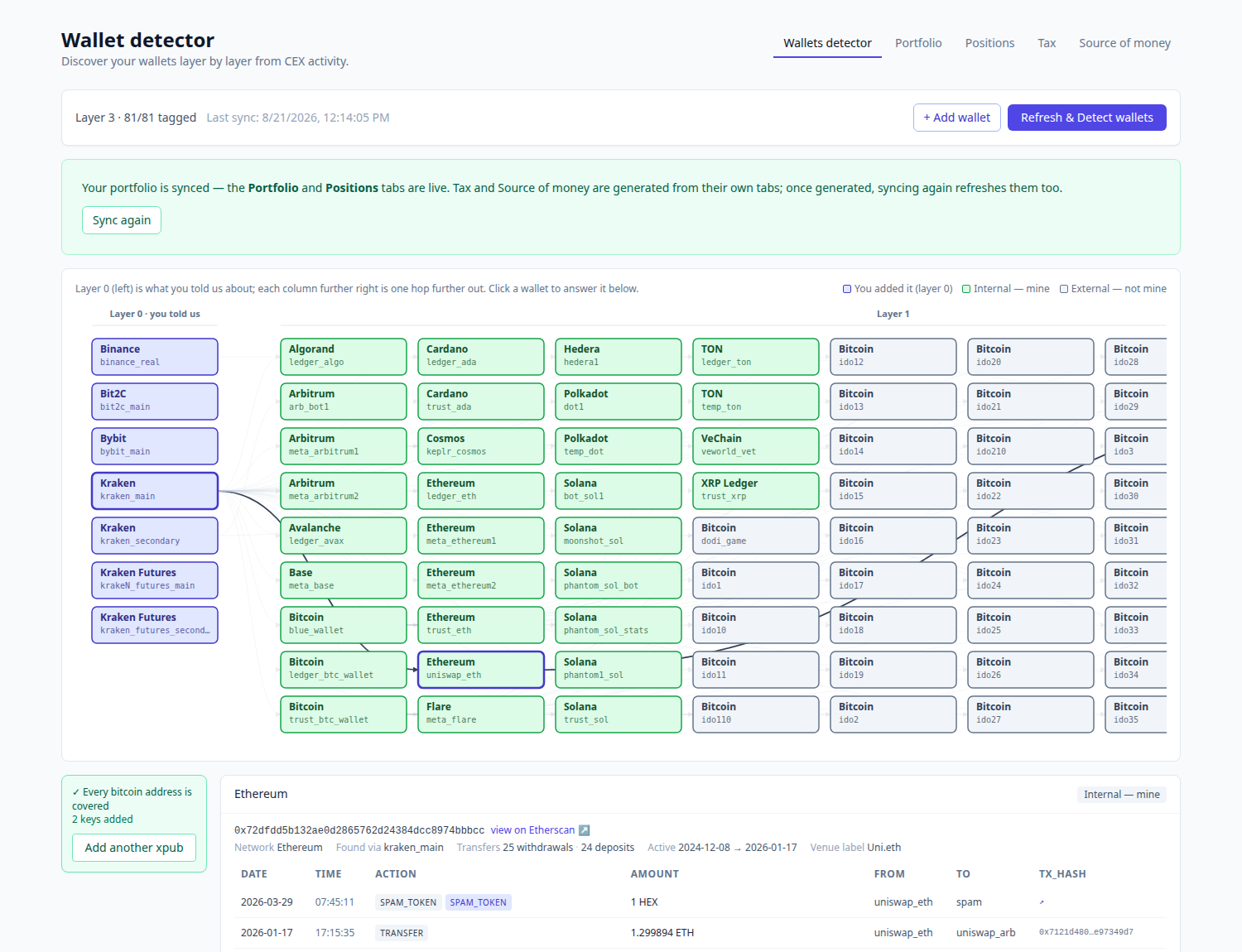
We find the wallets your client forgot
Every other tool begins by asking for a list of addresses — and is wrong by exactly the amount that list is incomplete. A missed wallet turns into a zero cost basis and a phantom gain, and it is the accountant who chases the client for it.
NetoFi starts from the few accounts only your client could know about, then follows the money outward layer by layer, surfacing each counterparty with its evidence and asking one question: theirs, or not?
The wallet list ends up complete by construction, not by the client's memory — the completeness half of the closed-loop proof, and exactly what a bank means when it asks "is this all of it?"
Your true portfolio — DeFi and futures included
Most crypto-tax tools stop at spot holdings. The moment a client provides liquidity on Uniswap, deposits into Aave, or opens a perp, those positions vanish from the balance — so the totals are simply wrong.
We track every position — liquidity, lending, staking, open futures — as a first-class holding at its true value, today and at every point in history. If the exchange shows it, your portfolio shows it.
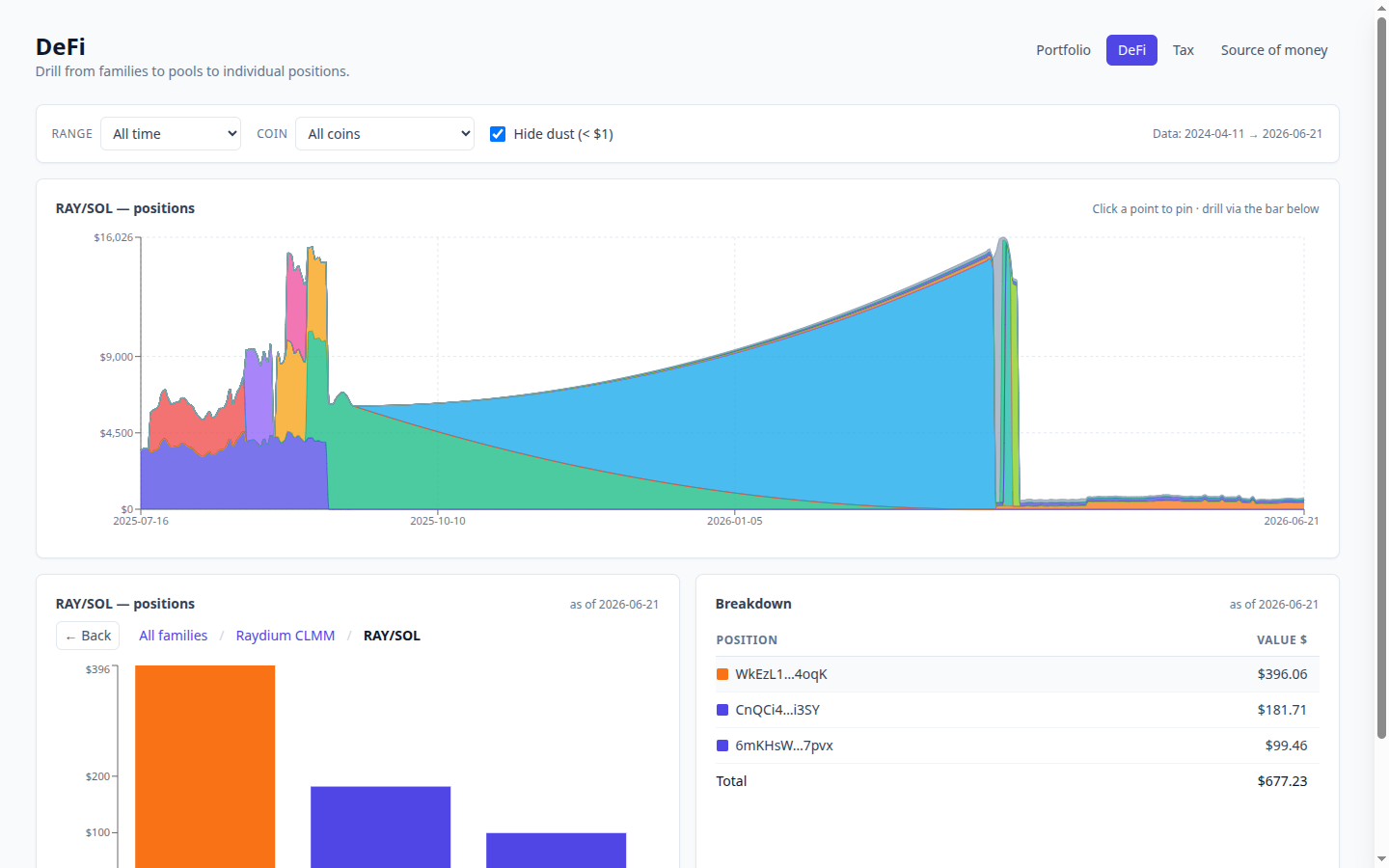
Powerful DeFi drill-downs
Watch DeFi value over time, then drill from project level to the individual positions inside them.
New protocols are quick to add: the classifier architecture is built to extend, not rewrite.
Open futures, not just the profit after you close
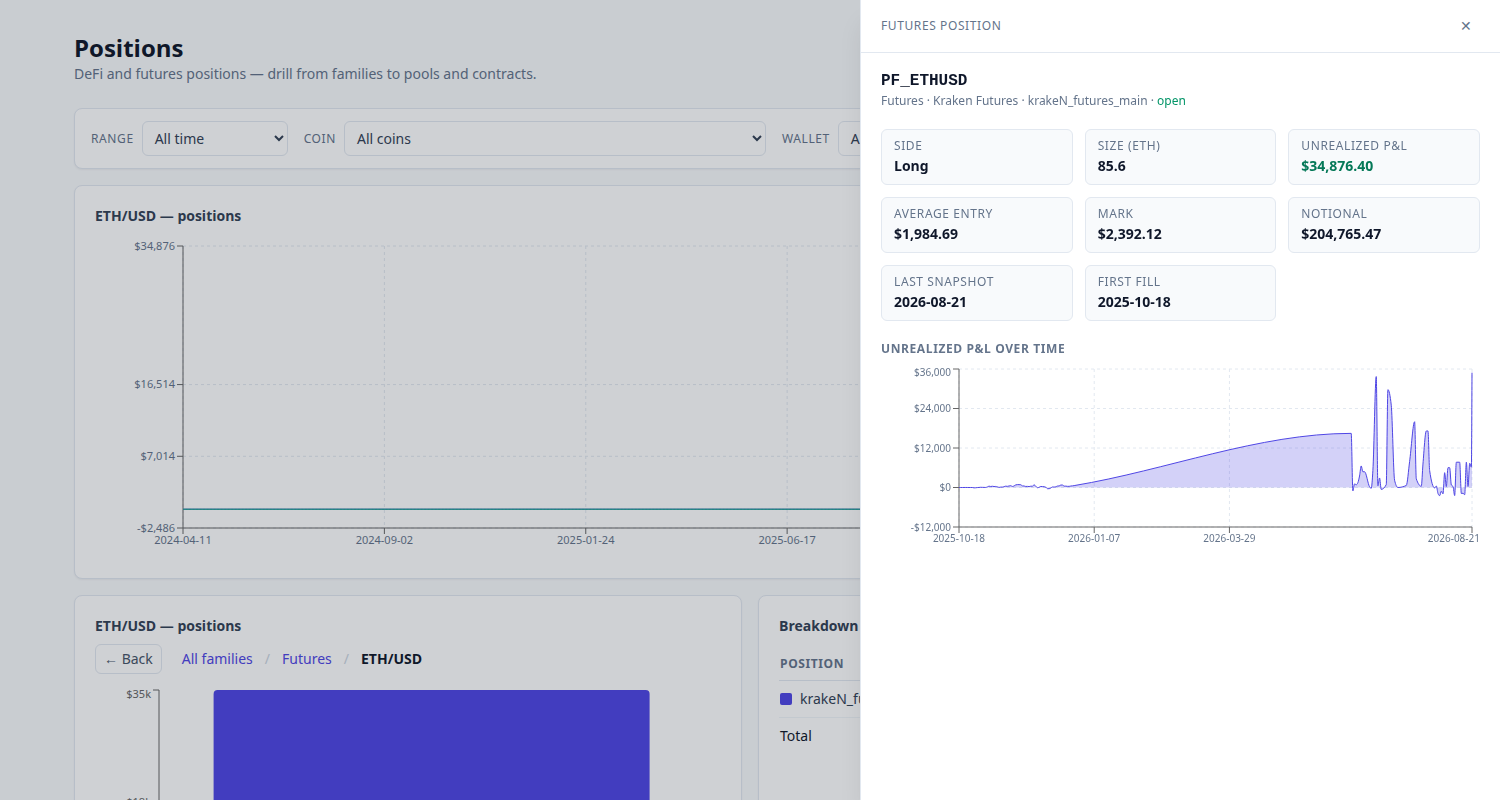
Leading tools import a futures trade only once it is closed — a single profit-or-loss line, with no record that the position ever existed. One of the largest doesn't support derivatives at all. So a client sitting on an open perp is shown a portfolio worth a fraction of what the exchange shows them.
NetoFi carries the position itself — size, average entry and unrealized P&L — counted in portfolio value today and at every point on the historical chart, and reconciled against the venue's own position on every run.
A position held across a year-end stays one position — instead of being split into a phantom loss in one tax year and a phantom gain in the next.
Every figure traces to its source
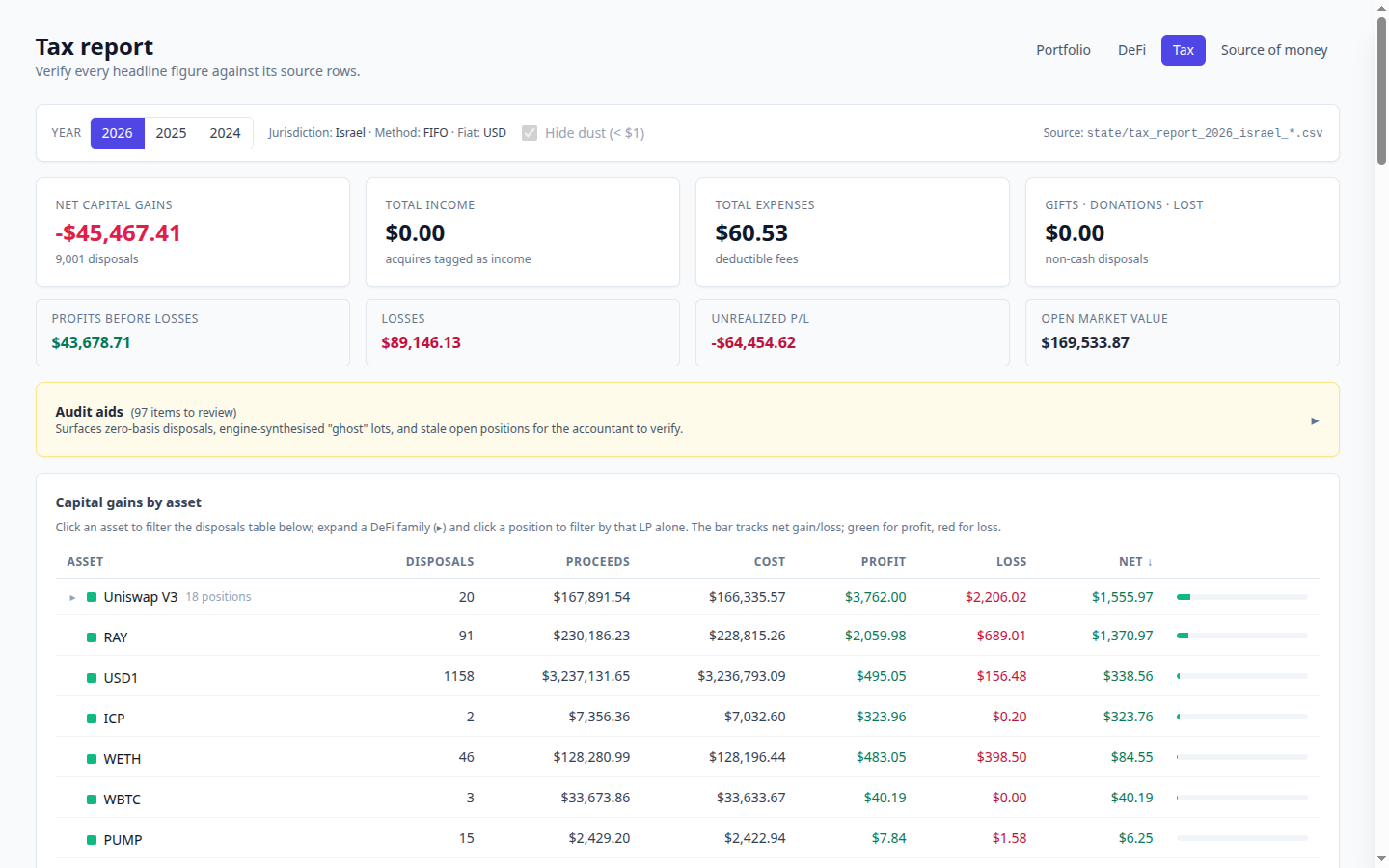
The goal of our proactive UI is to provide accountants with a powerful tool to trace, debug and validate all numbers in our report. Capital gains, income, expenses, and gifts — each headline number expands to the cost-basis lots behind it, with the ability to link to all physical transactions. Your work shifts from rebuilding the numbers to reviewing them.
Audit aids surface zero-basis disposals and stale open positions for the accountant to verify.
The closed-loop proof
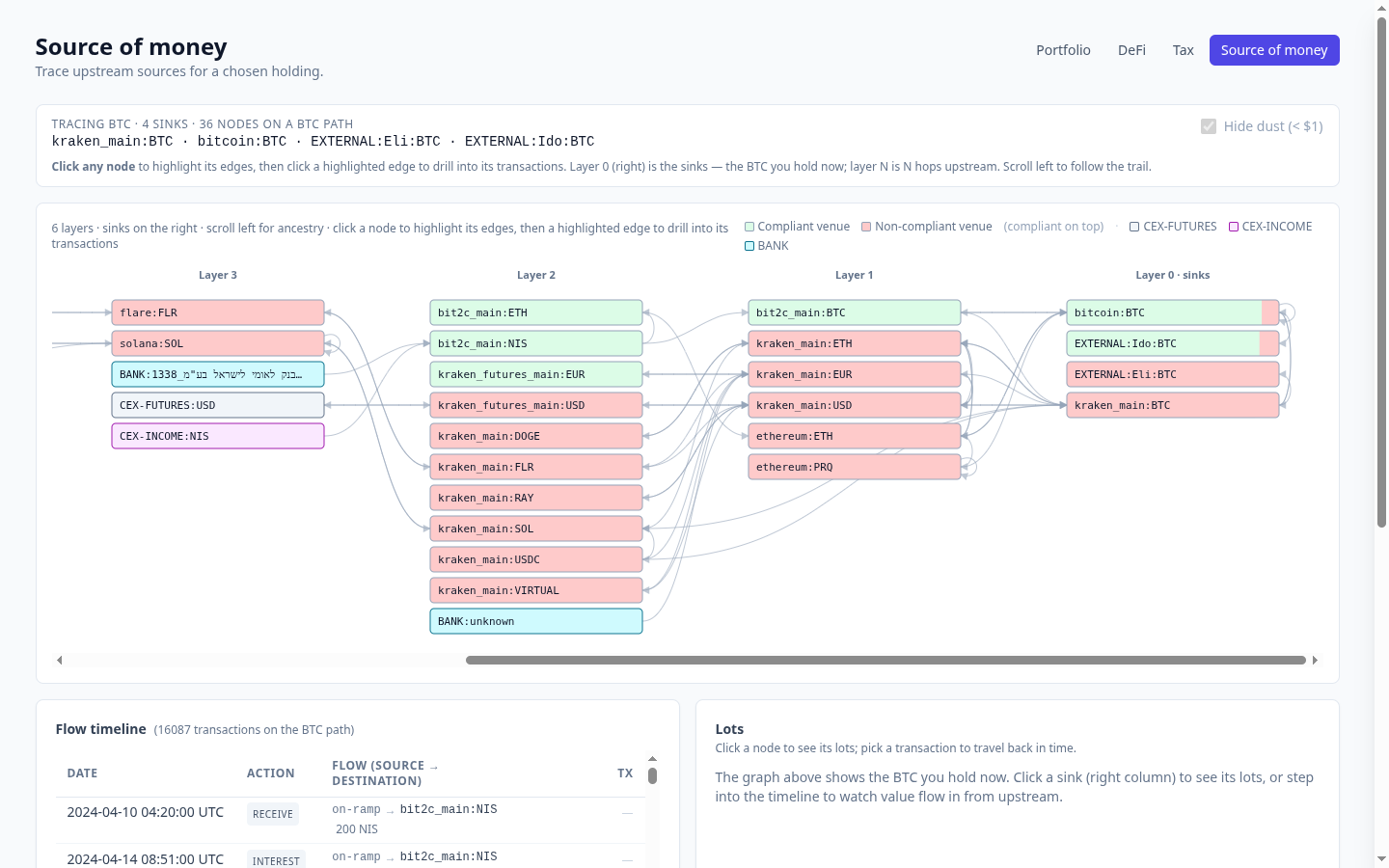
Configure your bank's policy once (Bank Leumi today). The graph reconstructs the full circuit — bank deposits in, whitelisted exchanges, every wallet, back to the wire. Green means the lot never left the whitelist; red names the first hop where it did, and why. A forgotten wallet? Declare it and it turns green. A genuine external payment? Documented and isolated — never a cloud over the whole account.
The answer to the bank's real question — "is this all of it, and where did every unit come from?" — proven lot by lot, not scored.
Why it's different
We prove the loop is closed — screeners check for bad neighbours
A bank clears a crypto wire through two gates. Screening tools (Chainalysis, TRM) answer the first: "any exposure to bad actors within a few hops?" — a negative test that stops at the first labelled entity. NetoFi answers the second: a positive, complete accounting that every unit across your wallets descends from declared, bank-acceptable origins — however many hops it takes — with out-of-policy activity isolated lot by lot instead of clouding the account. Keep your screening tool; no screening tool can produce this.
A conservation invariant, checked on every run
The engine proves — portfolio-wide, in its test suite — that no cost basis is created or destroyed. To our knowledge, no consumer crypto-tax product exposes such a check.
Liquidity positions taxed at their native unit
We model an LP position by its actual liquidity, not as a $0 NFT or a pair of spot disposals — so top-ups and partial closes keep their basis instead of leaking it.
Published methodology
Our tax treatments are written up as plain-language white papers, not hidden behind a black box. Read them, challenge them, sign off on them.
Configurable per jurisdiction / bank (compliance)
Tax treatment is a config file, not a code change — and so is each bank's compliance policy for source-of-funds. Plenty of tools do jurisdictions; the configurable bank/compliance layer is what sets this apart. Israel and Bank Leumi are wired today.
Derivatives valued as positions, not just P&L
Leading tools record a futures trade as realized profit on the day it closed — one of the largest states plainly that it doesn't support derivatives at all, and another that it never even sees the trade being opened. We model the position: an open perp is part of the balance and part of the historical chart, and one held across a year-end isn't split into a phantom loss and a phantom gain. Kraken Futures and Binance Futures are reconciled against the venue's own position on every run; Bybit derivatives run the same path.
Easily extensible via AI. Supported today:
Exchanges
Networks
DeFi features
Who's behind this

I spent 20 years at Google as an engineering manager and technical lead — most recently leading analytics teams, responsible for measurement and high-quality datasets used across Google's own apps. Getting numbers right, in systems people audit, has been my whole career.
Crypto has been my passion for several years now. I am a DeFi expert, and built automated DeFi trading strategies. This toolkit began to solve my own problem — taxing non-trivial DeFi activity is a genuine gap — and continued far beyond, with innovative automated source-of-funds reporting strategies.
The collaborator pilot
We're onboarding a small group of accountants. The exchange is simple: real reports for your clients, in return for your professional feedback — this is who we want feedback from.
Bring a few clients
Share the wallet and exchange data for a handful of clients you want reports for.
We produce the reports
We run the toolkit and deliver tax and source-of-funds reports for those clients — under a mutual confidentiality and data agreement (free of charge).
You evaluate, we improve
You stress-test the numbers and tell us what real client work needs. Your feedback shapes the product.
Prefer we just prepare your report?
Don't want to run the software yourself? We prepare a detailed source-of-funds or crypto tax report for your portfolio — the tracing, the reconciliation, the evidence — ready for a licensed accountant or lawyer to review and sign.
Source-of-funds report
We start by discovering the wallets in play — including the ones you had forgotten — then reconstruct the complete circuit of your funds, from bank deposits through whitelisted exchanges to today's holdings, and prove nothing entered unexplained. Out-of-policy activity is isolated lot by lot against the specific bank's own policy — including the "semi-clean" case where only some coins or transactions qualify — so the clean part stays wirable. Delivered as the interactive provenance dashboard plus a signable summary your professional attaches to the bank file.
from ₪4,000 + VAT
A fraction of a full external opinion — which runs into the tens of thousands — because the analysis is automated.
Crypto tax report
A full capital-gains and income report with DeFi handled natively — liquidity, lending, staking, perps and bridges — every figure tracing to the cost-basis lots and the underlying transactions behind it. Your true portfolio carries open futures positions at their unrealized P&L rather than ignoring them until you close, so a position spanning a year-end is reported as one position. Quality-tested and reconciled against the chain and each exchange on every run, so the numbers hold up under review.
from ₪1,500 + VAT
Built for the DeFi-heavy portfolios that off-the-shelf tools can't handle.
The exact price scales with the number of wallets and exchanges, chains, DeFi activity, transaction volume, and tax years — and is fixed on a short scoping call before any work begins. International clients quoted in local currency.
Scoping call
A short call to size the portfolio and agree a fixed quote and turnaround.
Secure data hand-off
You share the wallet and exchange data under a mutual confidentiality and data-processing agreement.
Report delivered
You receive the interactive report and a signable summary. You review, verify, and sign — we're the analyst layer, not the signatory.
Or WhatsApp +972 54 460 3109